
Southwest Florida Waterfront Homes
Southwest Florida waterfront homes sit on four different kinds of water, all within twenty minutes of each other, and only one of them lets a sailboat reach the Gulf. The listing photo will not tell you which one you are looking at — and the difference is worth six figures.
Four Kinds of Water, and Only One Gets a Mast to the Gulf
Every listing in this market says “waterfront.” In practice, Southwest Florida waterfront homes come in four completely different products, and the gap between them is the single biggest variable in what you pay and what you can actually do on a Saturday.
Sailboat access means no fixed bridges between your seawall and open water. Nothing overhead to duck. It is the scarcest and most expensive water in the region, and Punta Gorda is the benchmark for it.
Powerboat or bridged access means you reach the Gulf, but at least one fixed bridge caps your air draft on the way. Plenty of Port Charlotte canal streets are exactly this. For a center console it is irrelevant. For a trawler with a hardtop and antennas, it is the whole decision.
Lock-controlled access is South Gulf Cove, and it is its own category. The canal network is enormous, but every trip to open water passes through a single county-operated lock.
Freshwater and view-only is the fourth, and it surprises people. Rotonda West has twenty-six miles of canals that do not connect to salt water at all. Heron Creek’s lakes are stormwater and irrigation ponds — no boats, no Gulf, just the view. This is the most affordable water in the market and, for a lot of buyers, the right answer.
If you never plan to own a boat, buying sailboat-access frontage is the most expensive view in Southwest Florida.
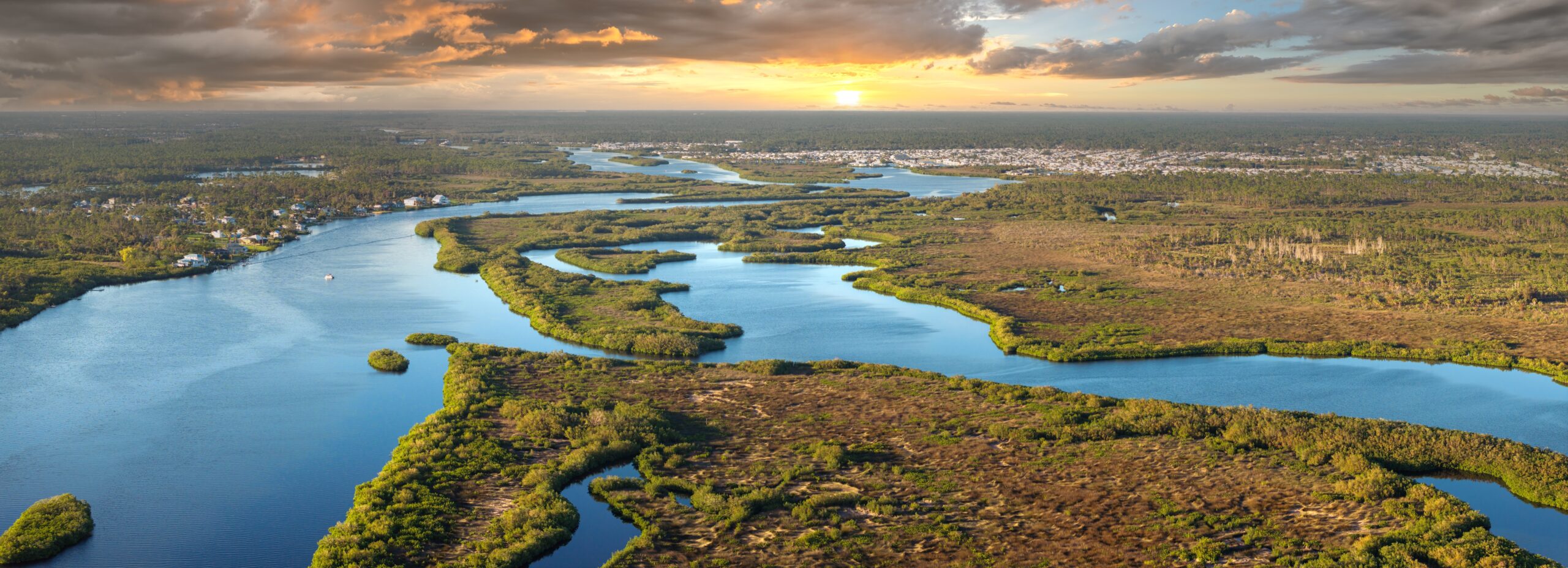
Six Places to Buy Southwest Florida Waterfront Homes
Same region, six very different answers to the only question that matters: can I actually get out?
Punta Gorda Isles & Burnt Store Isles
The benchmark for sailboat access. The city maintains 45 miles of canals and 91 miles of seawalls, and where a wall fails the city removes and replaces it — funded by a non-ad-valorem assessment on your district. PGI and BSI are separate districts with separate budgets.
Port Charlotte Canals
The largest canal inventory in the region and the widest spread in what “access” means street by street. Some runs are direct, some are a short hop, some carry a fixed bridge. Section 15 and Waterway Estates are where the sailboat-access lots concentrate.
South Gulf Cove
Roughly fifty miles of navigable canals and 15,053 deeded lots. Fewer than a third are waterfront, which makes dry lots here some of the best value near water in the county. Every boat trip out goes through the lock.
Gulf Cove
Smaller and older, sitting directly on the Myakka River with no lock in the way. The voluntary property owners association runs a private waterfront park and boat ramp. Read the full guide.
Rotonda West
Twenty-six miles of canals, none of them connected to salt water. Buy here for the water view, the wagon-wheel layout and the price — not for the boat.
Englewood & Manasota Key
Lemon Bay behind the barrier island, four public beach accesses on the key, and a county line running straight through town that changes your tax bill and your building department. Read the full guide.
Before You Write
Four Things to Confirm Before You Buy
Southwest Florida Waterfront Homes
Find out who owns the seawall.
Inside Punta Gorda city limits the city removes and replaces failed seawalls; you clear your dock, lift, irrigation and landscaping out of the way first. In unincorporated Charlotte County the wall is yours, and replacing it means a permit with signed and sealed engineering, a Notice of Commencement over $5,000, and possibly sign-off from the Florida DEP and the Army Corps of Engineers.
Measure the trip, not the frontage.
Ask which fixed bridges sit between the seawall and open water, and what the charted clearance is. Then ask about depth at low tide. A canal that floats a center console year-round may not float a sailboat in January.
Check that the dock and lift were permitted.
Charlotte County requires a permit to build, repair or alter docks, boat lifts and seawalls, and any electrical work must be done by a state-licensed electrical contractor on its own permit. Unpermitted marine work becomes your problem at closing, not the seller’s.
Pull the flood zone, the elevation certificate, and read the 50% rule.
In a FEMA high-risk zone, Charlotte County’s Substantial Improvement rule means any repair or remodel costing more than half the structure’s market value forces the whole building up to current code, elevation included. On a $250,000 structure that threshold is $125,000 — which a kitchen and two baths can reach. It does not apply in X or D zones.
Which Water Actually Fits You
Be honest about the second one. Most buyers shopping Southwest Florida waterfront homes overestimate how often the boat actually leaves the dock.
*Access, bridge clearance and canal depth vary by address, not by neighborhood. Confirm per-property before you write an offer.
Waterfront Homes FAQs
Straight answers to what buyers ask most before touring Southwest Florida waterfront homes.
No fixed bridges between the property and open water — nothing your mast has to clear. It is a market term, not a legal one, so confirm the route on a chart for the specific address rather than trusting the listing remark.
It depends which side of the city line you are on. In Punta Gorda the city removes and replaces failed seawalls, funded by the assessment on your canal district, and you are responsible for clearing your dock, lift and landscaping first. In unincorporated Charlotte County it is entirely the owner’s cost and the owner’s permit. See the City of Punta Gorda canal program and the Charlotte County seawall permit requirements.
Enough that you should ride it before you buy. The county studied a parallel lock for years; in September 2025 the commission stopped that design work over manatee-entrapment permitting concerns and redirected the effort to a tender house instead. Plan around one lock, not two.
Usually — but “included” is not the same as “permitted.” Ask for the permit history, and treat an unpermitted lift as a cost you are inheriting rather than a feature you are buying.
A lender will require it in a FEMA high-risk zone. Outside those zones it is optional and often surprisingly inexpensive — and since 2022 a lot of local buyers carry it regardless of what the map says.
Often, yes. An NFIP policy can be assigned to the buyer at closing and the discounts travel with it. Under Risk Rating 2.0 most rates are capped at 18% annual increases until the property reaches its full-risk rate, so a seller who has held a policy for years may be sitting on a number you cannot get by writing a fresh one. Ask before you assume you are starting over.
Tell Me What You Plan to Put on the Water
Send me the boat with its air draft and its draft. I will send back the Southwest Florida waterfront homes and streets that actually work for it, which ones carry a fixed bridge, and what the seawall situation is on each.